Affichage des articles dont le libellé est Psy Ops. Afficher tous les articles

mardi 4 octobre 2016

Psyop : Opération Syrie par Manlio Dinucci

Alors que l’émirat de Qatar promeut la tournée internationale d’une exposition sur les crimes attribués à la République arabe syrienne, Manlio Dinucci rappelle, documents à l’appui, ce que nous savons vraiment sur ce conflit.


Les « Psyop » (Opérations psychologiques), dont sont chargées des unités spéciales des forces armées et des services secrets états-uniens, sont définies par le Pentagone comme des « opérations planifiées pour influencer à travers des informations déterminées les émotions et motivations et donc le comportement de l’opinion publique, d’organisations et de gouvernements étrangers, afin d’induire ou renforcer des attitudes favorables aux objectifs préfixés ».
Exactement l’objectif de la colossale psyop politico-médiatique lancée contre la Syrie.
Après cinq années pendant lesquelles on a cherché à démolir l’État syrien, en le démantelant de l’intérieur par des groupes terroristes armés et infiltrés de l’extérieur et en provoquant plus de 250 000 morts, maintenant que l’opération militaire est en train d’échouer, on lance l’opération psychologique pour faire apparaître comme agresseurs le gouvernement et tous ces Syriens qui résistent à l’agression.
Fer de lance de la psyop : la diabolisation du président Assad (comme auparavant Milošević et Kadhafi), présenté comme un dictateur sadique qui prend plaisir à bombarder des hôpitaux et à exterminer des enfants, avec l’aide de son ami Poutine (dépeint comme un néo-tzar de l’empire russe renaissant de ses cendres).
C’est à cet effet que sera présentée à Rome, début octobre, à l’initiative de diverses organisations « humanitaires », une exposition photographique financée par la monarchie absolue du Qatar et déjà montrée à l’Onu et au Musée de l’holocauste à Washington à l’initiative des USA, de l’Arabie saoudite et de la Turquie : elle contient une partie des 55 000 photos qu’un mystérieux déserteur syrien, nom de code « Caesar », dit avoir prises pour le gouvernement de Damas dans le but de documenter les tortures et les meurtres des prisonniers, c’est-à-dire ses propres crimes (sur la crédibilité des photos voir les rapports ci-dessous).
En ce point une autre exposition est donc nécessaire, pour montrer toutes les documentations qui démolissent les « informations » de la psyop sur la Syrie.
Par exemple, le document officiel de l’Agence de renseignement du Pentagone, daté du 12 août 2012 (déclassifié le 18 mai 2015 grâce à l’initiative de « Judicial Watch ») : il rapporte que « les pays occidentaux, les États du Golfe et la Turquie soutiennent en Syrie les forces d’opposition pour établir une principauté salafiste en Syrie orientale, chose voulue par les puissances qui soutiennent l’opposition afin de d’isoler le régime syrien ».
JPEG - 9.5 ko
Cliquer sur l’image pour télécharger le document.
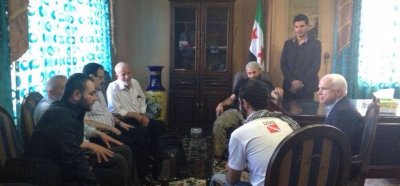
Cela explique la rencontre en mai 2013 (documentée photographiquement) entre le sénateur états-unien McCain, en Syrie pour le compte de la Maison-Blanche, et Ibrahim al-Badri, le « calife » à la tête de l’Isis.
JPEG - 18.8 ko
Sur cette photo (mai 2013), on voit le sénateur John McCain avec le futur calife Ibrahim, chef de Daesh (à gauche). Dans un courriel, le bureau du sénateur a qualifié notre interprétation de cette photographie d’« absurde », faisant valoir les menaces de mort de Daesh contre lui. Pourtant, un an plus tard, le sénateur lui-même admettait connaître les dirigeants de Daesh et être en contact permanent avec eux.
Le sénateur John McCain admet à la télévision, en octobre 2014, être en contact permanent avec les dirigeants de Daesh
Cela explique aussi pourquoi le président Obama autorise secrètement en 2013 l’opération « Timber Sycamore », conduite par la Cia et financée par Ryad avec des millions de dollars, pour armer et entraîner les « rebelles » à infiltrer en Syrie (voir le New York Times [1]).
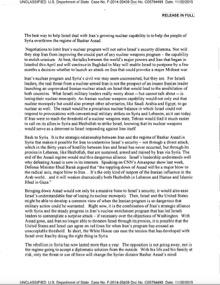
Une autre documentation se trouve dans les emails de Hillary Clinton (déclassifiés « number case F-2014-20439, Doc N° C057944983), où, en habit de secrétaire d’état, elle écrit en décembre 2012 que, étant donné la « relation stratégique » Iran-Syrie, « le renversement d’Assad constituerait un immense bénéfice pour Israël, et ferait aussi diminuer la crainte israélienne compréhensible de perdre le monopole nucléaire ».
JPEG - 30.7 ko
Cliquer sur l’image pour télécharger le document.
Pour démolir les « informations » de la psyop, il faut aussi une rétrospective historique sur la façon dont les USA ont instrumentalisé les Kurdes dès la première guerre du Golfe en 1991. À l’époque pour « balkaniser » l’Irak, aujourd’hui pour désagréger la Syrie. Les bases aériennes installées aujourd’hui par les USA dans la zone kurde en Syrie servent à la stratégie du « diviser pour régner », qui vise non pas la libération mais l’asservissement des peuples, y compris kurde.

mardi 13 septembre 2016

Inside Saudi Arabia’s Yemen war rooms


“Our position is extremely strong,” said Lieutenant General Fayyad al-Ruwaili. “We are hitting military targets on [the enemy’s] side, their facilities, their lines of communication…. At the end of the day, they will be the losers.”
The certainty with which the deputy chief of staff of Saudi Arabia’s armed forces outlined his country’s position seemed off-key, especially given the storm brewing around the kingdom’s 17-month intervention in Yemen.
Granted rare access inside the Saudi defence ministry to specialist cells where targeting decisions are taken, IRIN found a jarring disconnect between the cool calculations of the generals in Riyadh and the deaths of innocent civilians, women, and children on the ground.
Throughout IRIN’s guided tour, Saudi military officials insisted they are scrupulous in their targeting, abide by the rules of war, and are constantly honing what they do to avoid civilian casualties.
Al-Ruwaili said UN numbers on civilian deaths were not to be trusted.
“We are not saying that there have been [no civilian casualties]. Any military operation in a situation working against a guerrilla [force] would have some collateral damage or effect.” But the casualties are minimal, al-Ruwaili said.
“We choose our targets very carefully. We scrutinise the target list… and we have a no target list – it is thousands – and we do avoid all these targets.”
 
Annie Slemrod/IRIN
Lieutenant General Fayyad al-Ruwaili in Riyadh
 
Much of this decision-making happens inside an operations room that has a plaque, in English and Arabic, that reads “Joint Targeting Cell”. Despite its name, the choices about what to target don’t appear to be made here, only what not to hit.
There are topographic maps on one wall and more uniformed men in front of computers. A map of Yemen is projected on one side of a large screen. Coloured icons mark schools, hospitals, and known UN and NGO locations. Zooming into Sana’a, some labels were visible: a hospital, a Red Crescent location, and a college. The coordinates of these locations are shared by the groups themselves.
IRIN was shown a document from OCHA, the UN’s emergency aid coordination body. It listed the precise details of a planned aid convoy: driving times, exact coordinates, and photographs of vehicles.
A soldier explained how it works. If a static target is within 500 metres of a “no strike” location or a populated area, warplanes either won’t hit it or they’ll choose a less powerful weapon. This “targeting” cell was said to be in 24-hour coordination with pilots doing the actual bombing.
Lieutenant Colonel Turki al-Maliki of the air force rushed over from his offices next door to answer further questions about the difficult reality of asymmetric warfare. He joked that he is “the most hated guy in the air force” because he is the man who has to call off certain strikes.
Al-Maliki said Saudi Arabia is doing its best to limit civilian damage and constantly “improving the process”. “Does [our] collateral damage methodology ensure the safe execution [of warfare] for civilian people? It does,” he said, assuredly.
Self-investigation?
And when they do err, the Saudis said, they take full responsibility.
“We are humans and we do make mistakes,” said al-Ruwaili. In these cases “we have an independent investigation team that [does] the whole thing, and if we make a mistake we… acknowledge it.”
This process is done by what’s called the Joint Incident Assessment Team. In early August, the JIAT, a group of appointed experts from the Gulf region, released a summary of eight investigations into claims of attacks that violated international law.
In one case – July 2015 airstrikes on residential compounds connected to a power plant that Human Rights Watch said killed at least 65 civilians including 10 children – the team concluded that faulty intelligence had led to the hit, and promised to pay compensation to victims’ families.
In another case – a hit on an MSF hospital in Saada – the investigation found that Houthi rebel forces had been using the building but said the military should have notified the medical charity before the strike.
In the rest of the cases, including a marketplace bombing where Human Rights Watch and the UN reported between 97 and 107 civilian deaths and the JIAT found none – the investigations left the coalition in the clear. Al-Ruwaili said the JIAT is now looking at seven further cases.
But internal investigation isn’t good enough, according to Human Rights Watch and other critics, who argue that the Saudis should release details about panel members and full reports on each incident. The UN has also called for independent investigations.
Al-Ruwaili insisted there was no such need.
The team is headed by a retired two-star air force general “who is not working for the government anymore,” he said. “He is independent.”
Back on the ground
On the same day that IRIN visited the war’s Riyadh headquarters, ushered in out of the desert heat after a few questions and phone calls by a military policeman in a red beret, the UN upped its estimate of the death toll in Yemen to 10,000. For months, official numbers had lingered around 6,000. Given the scale of fighting, this had begun to beggar belief.
Up until June of this year, Yemeni civilians accounted for 82 percent of the deaths and injuries from Saudi-led coalition airstrikes, according to Action on Armed Violence, a group that monitors weapons violence worldwide and investigates the arms trade.
This mounting civilian toll means that the trade, when it comes to who is dealing with Saudi Arabia, is increasingly under the microscope.
It’s not just the airstrikes that cause suffering. The war has driven Yemen from what was already a humanitarian crisis before the war to what is now more like a full-blown catastrophe. More than half of its 26 million people are considered food insecure, 2.8 million (more than 10 percent of all Yemenis) have been displaced from their homes, and the vital healthcare sector is almost non-existent.
 
Almigdad Mojalli/IRIN
The aftermath of a coalition bombing in the early months of the war
 
Watchdog groups have accused the Saudi-led coalition of killing civilians and targeting civilian infrastructure. An early August report by the UN High Commissioner for Human Rights detailed hits on weddings, homes, markets, and civilian infrastructure. It also listed abuses by the Houthis and other parties to the conflict, which is no longer a fight between just two sides.
Put simply, Yemen has become harder to ignore.
There was particular indignation recently when the UN, under the threat of Saudi Arabia pulling its funding from vital humanitarian programmes, suspended the coalition from a list of violators of children’s rights.
A fraying alliance
Behind the sun-bleached high walls of the Ministry of Defence in Riyadh, where the General Staff Command is running the air campaign in Yemen, all appeared calm, on message, and, according to the officials, was running like clockwork.
But events on the ground told a very different story. Houthi shelling had just killed a three-year-old boy in the Saudi border city of Najran; there was “carnage” in the southern Yemeni city of Aden thanks to a suicide bombing claimed by so-called Islamic State; and the medical charity Médecins Sans Frontières had just announced it was pulling out of the north of Yemen after another of its facilities was hit.
Al-Ruwaili, previously chief of the Royal Saudi Air Force, was conspicuously unruffled. Bespectacled, with a closely shorn beard, and accompanied by several uniformed colleagues, he spelt out the status of his kingdom’s first-ever major foreign war in matter-of-fact terms.
Despite the growing criticism of UK arms sales (which had not quite risen to its current furore), he expressed confidence that Saudi Arabia’s allies remained on side. “We appreciate the support and help of the international community, and top of the list are our friends the Americans and the Brits.
“They understand the reasons behind the operation… they appreciate the situation [and what] we are doing.”
At the war’s outset, this certainly appeared the case.
Backed by a 10-state coalition, including all the Gulf countries, Saudi Arabia unleashed its first airstrikes on Yemen in late March 2015 after the internationally recognised president, Abd Rabbu Mansour Hadi, had been placed under house arrest by Houthi rebels in the capital Sana’a (he eventually fled and found refuge in Saudi Arabia).
When Saudi Arabia and its allies said they were intervening at the request of the “legitimate government of Yemen”, a term they still use, the United States and Britain, and most of the international community (save Iran), expressed support. The Sunni kingdom also portrays the Shia Houthis as a dangerous Iranian proxy and a threat to their shared border – al-Ruwaili mentioned the threat of “another Hezbollah”.
On the first day of airstrikes, a spokesperson for the US National Security Council said the action was “to defend Saudi Arabia’s border and protect Yemen’s legitimate government”. The United States promised to provide logistical and intelligence support to the operations. Britain followed suit. The French offered their assistance too.
Although there’s been no change of policy from Washington or London, domestic pressure has been building steadily on both administrations and there are signs that political and military alliances are beginning to fray as the civilian toll mounts.
The propaganda war
But while unease with the war is palpable in foreign capitals, it was nowhere to be seen at Saudi HQ, where the line was strictly that this war is for, not against, the Yemeni people.
Pointing to the three or four million Yemenis who live in Saudi Arabia and send home remittances, al-Ruwaili said: “We are there to help the Yemeni people.”
“I think the majority of the Yemeni people look at our operation as one that is designed to help them, to stabilise Yemen, to have a prosperous Yemen that is ruled by the Yemenis – ruled by somebody they choose.”
But while some Yemenis may be on side with the Saudi action, others clearly need a little persuading.
To that end, IRIN was shown leaflets in the operations room. The officials explained that they are dropped to bring locals onside, as are fliers warning civilians to stay away from specific military targets.

The propaganda or PSYOPS (Psychological Operations) material IRIN was shown is in simple to understand comic-strip form. In one two-panel strip, the first box shows a grinning man, traditional Yemeni dagger in his belt. In the background is a smiling girl with a backpack and another equally jubilant boy with a balloon.
The text reads: “Before the Houthi militias' coup.”
In the second frame, the same man has stubble and a grim, toothy expression. His clothes are ragged, the dagger is gone, and the buildings that the children strode in front of are in flames.
“After the Houthi militias' coup,” it says.
mardi 9 février 2016

Ted Cruz PsyOp

Pour la première fois dans l’Histoire, une équipe spécialisée dans les opérations psychologiques tente de fabriquer un candidat à l’élection présidentielle états-uniennes et de le porter à la Maison-Blanche. Sa victoire, si elle y parvenait, attesterait de la possibilité de falsifier le processus électoral lui-même. En outre, elle poserait la question du pouvoir des militaires sur les institutions civiles.

Less « opérations psychologiques » (Psy Ops) sont des « ruses de guerre » à l’image du Cheval de Troie. Sous l’influence du général Edward Lansdale, les États-Unis ont doté leurs armées et la CIA d’unités spécialisées, d’abord aux Philippines, au Vietnam et contre Cuba, puis de manière permanente .

Les opérations psychologiques sont beaucoup plus complexes que la propagande qui ne vise qu’à déformer la perception de la réalité. Par exemple, durant la guerre contre la Syrie en 2011, la propagande alliée consistait à convaincre la population que le président el-Assad allait fuir, comme le président Ben Ali l’avait fait avant lui en Tunisie. Les Syriens devaient donc se préparer à un nouveau régime. Tandis que, début 2012, une opération psychologique prévoyait de substituer aux chaînes de télévision nationale de faux programmes mettant en scène la chute de la République arabe syrienne de sorte que la population n’oppose plus aucune résistance.

De même qu’il existe aujourd’hui des armées de mercenaires, tel que Blackwater-Academi, DynCorp ou CACI, il existe pareillement des compagnies privées spécialisées dans les opérations psychologiques dont la britannique SCL (Strategic Communications Laboratories) et sa filiale états-unienne Cambridge Analytica. Dans le plus grand secret, elles aident la CIA à l’organisation de « révolutions colorées » et s’essaient désormais à la manipulation des électeurs. Depuis 2005, elles participent au salon britannique Defense Systems & Equipment International (DSEi) et vendent leurs services au plus offrant [3]. Dans l’exemple syrien, SCL a travaillé début 2011 au Liban où elle a étudié les possibilités de manipulation de la population communauté par communauté.

Dans les sociétés modernes, les autorités politiques sont désignées par la voie électorale. Cela peut aller d’un simple choix —selon leurs qualités personnelles— entre des candidats pré-sélectionnés jusqu’à la désignation de personnalités porteuses d’un projet politique déterminé. Dans tous les cas, les candidats doivent s’appuyer sur des militants ou sur des employés pour mener leur campagne. On sait que le vainqueur est presque toujours celui qui est parvenu à rassembler derrière lui le plus grand nombre de militants. Il convient donc, non seulement de fabriquer un candidat, mais aussi un parti ou un mouvement pour le soutenir. Or, les électeurs hésitent aujourd’hui à s’inscrire dans une organisation et les employés coûtent cher. SCL a eu l’idée d’utiliser les techniques comportementales pour fabriquer un parti politique qui portera son client au pouvoir. Ses psychologues ont dressé le profil-type du militant sincère et manipulable, puis ils ont collecté des données sur la population-cible, ont déterminé qui correspondait à leur profil-type, et ont déterminé les messages les plus efficaces pour les convaincre de soutenir leur client.
Pour la première fois, cela vient d’avoir lieu à une grande échelle : aux États-Unis avec Ted Cruz.
Robert Mercer, un des dix principaux donateurs de la vie publique états-unienne, a indirectement payé plus de 15 millions de dollars à SCL-Cambridge Analytica pour qu’il prenne en charge la campagne de Ted Cruz [4].
Inventeur d’un logiciel de reconnaissance vocale, Mercer est aujourd’hui le patron de Renaissance, une société de placement parmi les plus efficaces au monde. Ainsi son célèbre fonds Medaillon a-t-il réalisé de 1989 à 2006 en moyenne 35 % de profit par an tout en mettant au point un système d’évasion fiscale pour ses clients [5].
Robert Mercer ne s’est jamais exprimé publiquement sur ses opinions politiques et les commentateurs US ne savent pas trop comment classer ce « républicain ». On ignore par exemple ses positions sur les problèmes de société comme le droit à l’avortement ou le mariage gay. Tout au plus sait-on qu’il ne croit pas que les changements climatiques soient provoqués par l’activité humaine. Toujours est-il qu’il combat clairement Hillary Clinton et son ami Donald Trump, et qu’il est proche de John Bolton.
Pour sélectionner les citoyens susceptibles de devenir des militants, SCL/Cambridge Analytica a secrètement réuni des données personnelles sur des millions d’électeurs [6].
Le docteur Aleksandr Kogan a acheté les données d’Amazon, le géant de la vente en ligne aux États-Unis, puis il a payé environ 1 dollar supplémentaire par client pour qu’un questionnaire lui soit adressé via Mechanical Turk (MTurk). En acceptant de s’identifier via Facebook, l’internaute laissait MTurk avoir accès à ses données personnelles qui les croisait avec celles d’Amazon et les transmettait via la société de Kogan, Global Science Research (GSR), à SCL. Bien que le docteur Kogan ait assuré le Guardian ne travailler qu’à des fins de recherche scientifique et uniquement sur des données anonymes, elles sont aujourd’hui en possession de SCL [7].
En quelques mois, SCL disposait d’une base de donnée détaillée sur plus de 40 millions d’électeurs US, à leur insu.

L’interprétation des données personnelles

Cambridge Analytica a alors procédé à une évaluation de chaque profil selon la méthode OCEAN, c’est-à-dire :
- « Ouverture » (appréciation de l’art, de l’émotion, de l’aventure, des idées peu communes, curiosité et imagination) ;
- « Conscienciosité » (autodiscipline, respect des obligations, organisation plutôt que spontanéité ; orienté vers des buts) ;
- « Extraversion » (énergie, émotions positives, tendance à chercher la stimulation et la compagnie des autres, fonceur) ;
- « Agréabilité » (tendance à être compatissant et coopératif plutôt que soupçonneux et antagonique envers les autres) ;
- « Neuroticisme » (tendance à éprouver facilement des émotions désagréables comme la colère, l’inquiétude ou la dépression, vulnérabilité).
Pour chaque sujet, il est parvenu à établir un graphique de personnalité en utilisant les 240 questions des tests NEO PI-R (Neuroticism-Extraversion-Openness Personality Inventory-Revised).
Sur cette base, SCL a identifié les individus qui constitueraient des militants sincères et manipulables, puis elle a élaboré des arguments personnalisés pour les convaincre.
On pourrait penser que des études de personnalité élaborées à l’insu des sujets seraient trop approximatives. Et pourtant…

Le candidat Ted Cruz

Le candidat qu’il s’agit de porter à la Maison-Blanche, Ted Cruz, est un excellent juriste, brillant orateur et débatteur. Il a notamment plaidé plusieurs fois avec succès à la Cour suprême des États-Unis. C’est un libertarien plutôt qu’un conservateur.
Son père, le pasteur évangélique Rafael Cruz, est un émigré cubain qui prêche le mandat que Dieu aurait donné aux hommes de foi de gouverner « l’Amérique ». Il assure qu’à la fin des temps, qui ne saurait tarder, Dieu donnera aux justes les richesses des méchants [8].
L’épouse de Ted, Heidi Cruz, était directrice pour l’Amérique du Sud au Conseil national de sécurité à l’époque de Condoleezza Rice, puis vice-présidente de Goldman Sachs chargée de la gestion de fortune des clients du Sud-Ouest du pays [9].
Au début de la campagne présidentielle, Ted Cruz était crédité de peu d’opinions favorables et la presse rapportait sa personnalité très peu empathique. Cependant, grâce à l’aide de SCL/Cambridge Analytica, il s’est rapidement constitué un vaste groupe de soutien et a gagné les primaires républicaines de l’Iowa.

En 1988, Ted Cruz affirmait son idéal dans la vie : « Prendre le contrôle du monde. La domination mondiale, tout gérer, être riche, puissant, ce genre de trucs ».
Son éventuelle accession à la Maison-Blanche prouverait la possibilité de subvertir une campagne électorale en recourant aux techniques des opérations psychologiques.

 Edward Lansdale’s Cold War, Jonathan Nashel, university of Massachusetts Press, 2005.
[2] « L’OTAN prépare une vaste opération d’intoxication », par Thierry Meyssan, Komsomolskaïa Pravda (Russie), Réseau Voltaire, 10 juin 2012. « PsyOp imminente de l’OTAN contre la Syrie », Réseau Voltaire, 20 juillet 2012.
[3] “You Can’t Handle the Truth. Psy-ops propaganda goes mainstream”, Sharon Weinberger, Slate, September 2005.
[4] “The Man Who Out-Koched the Kochs”, Annie Linskey, Bloomberg, October 23, 2014.
[5] “Renaissance Avoided More Than $6 Billion Tax, Report Says”, Zachary R. Mider, Bloomberg, July 22, 2014.
[7] “Ted Cruz sing firm that harvested data on millions of unwitting Facebook users”, Harry Davies, The Guardian, December 11, 2015.
[9] “Heidi Nelson Cruz, Ted’s Wife : 5 Fast Facts You Need to Know”, Tom Cleary, Heavy, March 23, 2015. “Heidi Nelson Cruz : A Political Spouse Making Sacrifices and Courting Donors”, Steve Eder & Matt Flegenheimer,The New York Times, January 18, 2016.


Thierry Meyssan